

Climate change, natural disasters and man-made disasters are seriously threatening the security of water sources, especially Vietnam's rivers, which depend mainly on external water sources.
El Nino refers to the abnormal warming of the sea surface in the central and eastern equatorial Pacific region, lasting for 8-12 months or even longer. It typically occurs every 3-4 years, but the frequency can vary.
With warnings about its formation and the potential for strong intensity, El Nino 2023 has the potential to create extreme weather conditions such as heatwaves, reduced rainfall, and drought. This poses a risk of adverse impacts on various aspects of life and production. Understanding this phenomenon, along with up-to-date information on its current status and forecasted progression, helps in being proactive in building and adjusting plans, as well as implementing appropriate preventive measures.
 In the downstream area of Son La hydropower plant, people can walk from one side of the river to the other with a shallow riverbed full of sand, stones, and gravel. This area is often flooded tens of meters deep. Photo taken in June 2023.
Impact of El Nino on Vietnam's Weather and Climate
Research has shown that the presence of El Nino can affect the weather and climate conditions in Vietnam in the following ways:
During El Nino conditions, the number of tropical storms and typhoons is significantly lower than the multi-year average, with a reduction of about 28%. On average, Vietnam experiences around 10-12 tropical cyclones, including storms and tropical depressions, in the South China Sea, of which 5-7 cyclones (approximately 0.58 cyclones per month) directly affect the mainland. In El Nino years, the average number reduces to 0.42 cyclones per month. Additionally, during El Nino conditions, tropical cyclones tend to concentrate in the middle of the storm season (July, August, and September).
The frequency of cold air outbreaks affecting Vietnam is lower than normal. During El Nino conditions, the average monthly temperatures are higher than usual, and the temperature difference between winter and summer becomes more distinct, with the southern regions experiencing a more significant impact than the northern regions. Due to the influence of El Niño, especially during strong El Nino events, many absolute record high temperatures have been recorded in various locations.
El Nino often leads to a decrease in rainfall across most regions of the country, ranging from 25% to 50%, with the most significant impact observed in the North Central Coast. This increases the risk of widespread or localized drought in areas with high water demand for production and daily activities.
However, while overall rainfall tends to decrease during El Nino conditions, there can still be records of the highest 24-hour rainfall. For example, the historical heavy rainfall in late July 2015 in Quang Ninh province occurred during El Nino conditions. Similarly, the major floods and historic inundation in late September 2009, following Typhoon Ketsana, affected provinces such as Quang Nam and Quang Ngai. The peak flood 2009 exceeded the level 3 warning along the main rivers from Quang Binh to Phu Yen and coincided with the El Nino phase. This indicates that El Nino increases the variability of rainfall in Vietnam.
Assessment of El Nino 2023 and its Impact on Vietnam
In May 2023, sea surface temperatures (SST) were higher than normal in most areas of the equatorial Pacific. Furthermore, the weak convergence that prevailed throughout April transitioned to near-normal easterly winds in the lower-level (trade winds) over the central equatorial Pacific, indicating the presence of El Niño.
This information was confirmed by the United States National Oceanic and Atmospheric Administration (NOAA) in June 2023 when sea surface temperatures were found to be 0.5 degrees Celsius above the climate average threshold for establishing El Nino conditions. It is forecasted that El Nino will gradually intensify during the winter months of 2023-2024.
Based on climate statistics, several potential impacts on Vietnam in the near future can be noted: Tropical storms and typhoons may be fewer in number, concentrated in the middle of the season, and exhibit complex and non-linear behavior; The frequency of cold air outbreaks from the north may be lower than usual, resulting in delayed and early-ending winters; Average monthly temperatures are likely to be higher than multi-year averages, leading to the possibility of severe heatwaves and more hot days compared to 2022; Overall rainfall is expected to be less than the average, with reductions ranging from 25% to 50%, particularly affecting the northern regions, but extreme rainfall events are still possible.
Precautions should be taken to mitigate the risks of drought, saltwater intrusion, and water shortages in early 2024 across the country. Previous El Nino events in 2015-2016 and 2019-2020 have resulted in record-breaking droughts and saline intrusion in many parts of Vietnam. Therefore, proactive measures should be in place to mitigate the impacts of El Niño.
Another noteworthy point is the compounded impact of El Nino and climate change, where El Nino events may exacerbate the occurrence of climate extremes. We have just experienced the hottest eight years on record, and the presence of El Nino in 2023, coupled with global warming trends, could lead to new heatwaves and the potential for breaking temperature records established in 2016. Efforts to reduce greenhouse gas emissions and mitigate climate change can help alleviate the severity of these impacts.
Lessons Learned from Coping with El Nino 2019/2020
The severe saline intrusion during the dry season of 2019-2020 in the Mekong Delta region was the most severe in history, attributed to the impact of El Niño. However, the extent of damage to agriculture and livelihoods was significantly reduced compared to the El Nino event in 2015-2016. The following lessons can be drawn from this drought and saline intrusion event:
Specialized agencies performed well in forecasting saline intrusion. Early identification of the timing of saline intrusion was crucial in arranging appropriate agricultural production structures based on water availability.
Timely and effective implementation of coping measures by the Government's leadership, ministries, and sectors through early management and response played a vital role, particularly in zoning, reduction, and shifting of production seasons to avoid saline intrusion.
The resolute engagement of Provincial Party Committees, People's Committees, and departments in provinces and cities in implementing the directions of the Government, ministries, and sectors led to timely and effective coping measures.
Proper allocation of land area and seasonal structures (sowing time) in accordance with the dynamics of saline intrusion and water availability proved to be an effective solution to cope with saline intrusion.
Increased awareness among the local population regarding the risks, dynamics, and impacts of saline intrusion resulted in the application of experiences, innovative ideas, and proactive measures while adhering to the recommendations of specialized agencies, leading to significant damage reduction.
Overall, these lessons highlight the importance of early forecasting, proactive management, effective implementation of coping measures, appropriate agricultural planning, and enhanced public awareness in mitigating the impacts of El Nino events and saline intrusion.
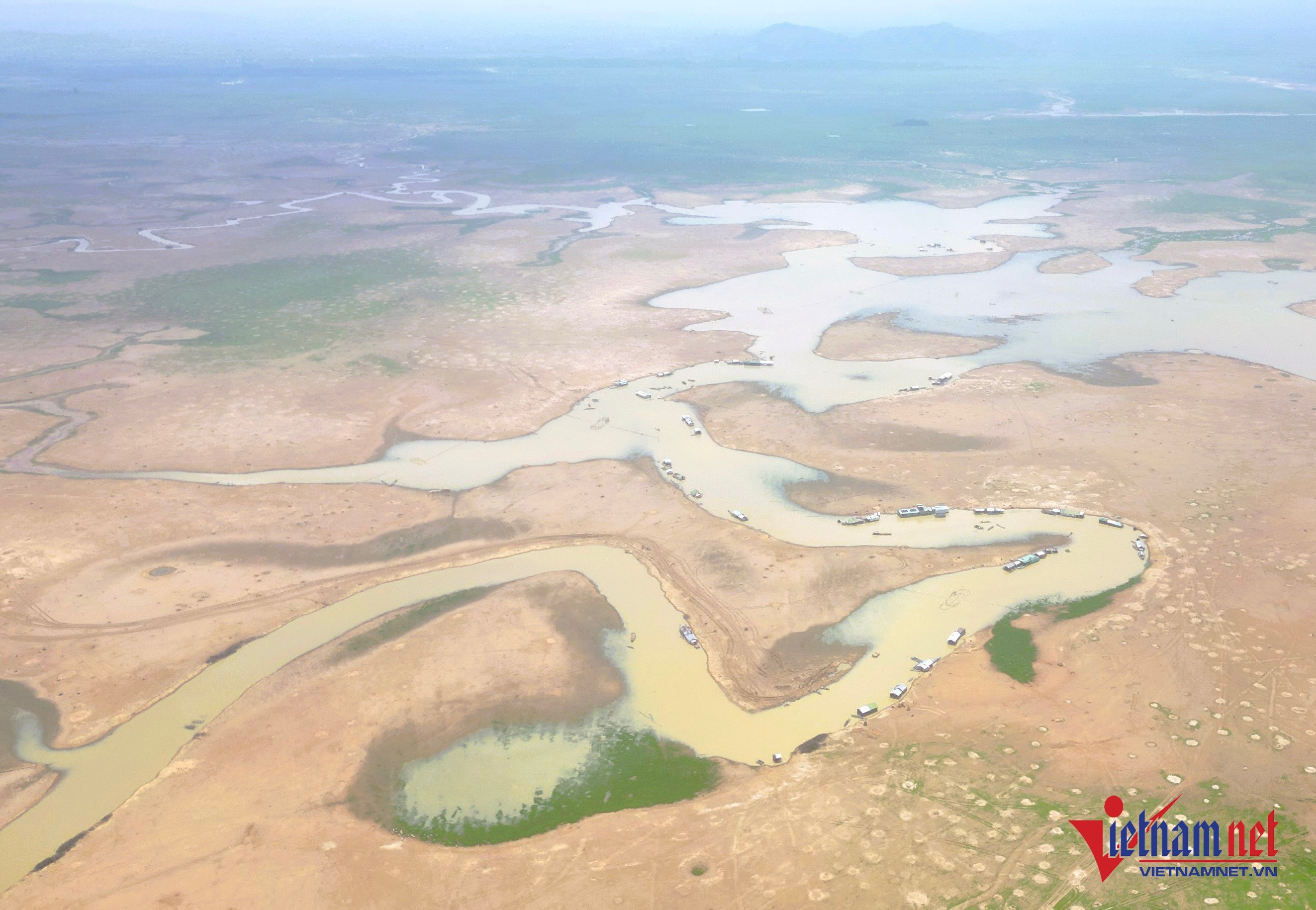 Prolonged drought makes Tri An lake inert. Photo taken in May 2023.
Immediate Actions to Prepare for El Nino 2023
Viet Nam Meteorological and Hydrological Administration agencies, along with relevant entities, should develop specific coping plans. This includes increasing monitoring and frequency of specialized bulletins on El Nino phenomena, rainfall forecasts, and water resources in river basins, not only within Vietnam but also in transboundary river basins. Timely provision of forecast information and water source alerts will facilitate appropriate coping plans for ministries, sectors, and localities.
Localities need to review water resource calculations, assess water needs for production and daily activities, and develop specific impact scenarios for adjusting plans accordingly. This is especially important for the summer-autumn crop in the North Central Coast, Central Vietnam, and areas with significant tourism activities during the dry months of 2023.
Reservoirs should consider adjusting operation and production plans to cope with the risk of reduced rainfall and ensure water and energy security.
Efforts should be made to regulate and distribute existing water sources effectively while promoting water-saving practices.
In the long term, Vietnam needs to develop a water usage strategy and policies for preventing disasters related to El Nino. Capacity building for officials and organizations, as well as cooperation among government agencies, should be enhanced. Adequate budget allocation and timely planning to address abnormal weather phenomena are also crucial.
These measures aim to enhance preparedness, adaptability, and resilience to cope with the potential impacts of El Nino 2023.
Source: Vietnam Net
Loi Pham