
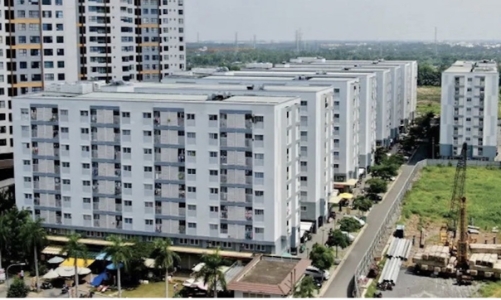
Amid the explosive demand for social housing in Hanoi, particularly from low-income groups and industrial zone workers, management efforts are facing unprecedented pressure
In just the past 3-5 months, the Hanoi Land Registration Office has received nearly 22,000 applications requesting confirmation of eligibility to purchase social housing, with the bulk concentrated at branches in Long Bien, Dong Anh, and Thanh Tri districts. On peak days, each branch handles 300-400 applications both in-person and online, while only 15-25 staff members manage tens of thousands of various administrative procedures.
At the dialogue conference titled “From Integrated Procedures to Stable Housing” organized by the Hanoi Public Administrative Service Center, delegates candidly pointed out that although the supply of social housing is showing positive signs thanks to supportive policies, the application receipt and approval process still faces numerous obstacles. Ms. Dang Bich Ngoc, Deputy Director of the Hanoi Land Registration Office, shared that the incomplete land database makes information lookup difficult. Many cases require sending verification documents to the former 30 district and town branches, while each current branch now oversees 3-5 new wards and communes, leading to severe overload.
Real-world situations at projects clearly reflect the market's intensity. Colonel Nguyen Van Dung, Deputy Director of the Investment Project Management Board under Corporation 319, recounted the Uy No social housing project in Dong Anh: In the early days of sales, thousands of residents flocked to queue, with some waiting overnight just to get a ticket number. The investor had to urgently set up tents, provide drinking water, seating, and schedule specific appointment times to ease hardships for the people.
Faced with these shortcomings, experts and leaders agreed that the long-term solution lies in strongly promoting digitization and data integration. Currently, Hanoi is implementing the “90 Days of Doing It Right, Fully, and Cleanly” campaign to digitize the massive paper archive, gradually perfecting the electronic database. Colonel Mai Tung Lam, Deputy Head of the Economic Security Department of the Hanoi City Police, emphasized the need to synchronize data across departments and agencies, enabling one-stop online application submission and avoiding situations where citizens have to submit documents multiple times. Even the application of AI technology to automatically scan and filter ineligible cases was proposed as a breakthrough step.
In addition, enhancing citizens' responsibility in truthfully declaring their housing ownership status will greatly support verification efforts, especially for cases without ownership certificates yet. At the same time, police forces urge residents to remain highly vigilant against scams on social media involving “priority quotas” or “internal quotas,” and absolutely avoid transferring money through unreliable intermediaries.
With these decisive steps, Hanoi aims not only to reduce the burden on management agencies but also to bring maximum transparency and convenience to citizens—those who truly need support to achieve stable housing and prosperous lives. This forms a crucial foundation for the sustainable development of the social housing program, contributing to building a more civilized and modern capital.
In the context of growing demand for social housing and the need to improve urban infrastructure in Hanoi, higher requirements are being placed on planning, administrative procedures, and transparency. Effective coordination among regulatory authorities, local governments, and the business community is therefore crucial. SD Link is an investment consulting and connection firm that provides planning and policy information, advises on legal procedures, and accompanies investors throughout project preparation and implementation, helping to remove bottlenecks and promote sustainable urban and social development.
Source: VnEconomy