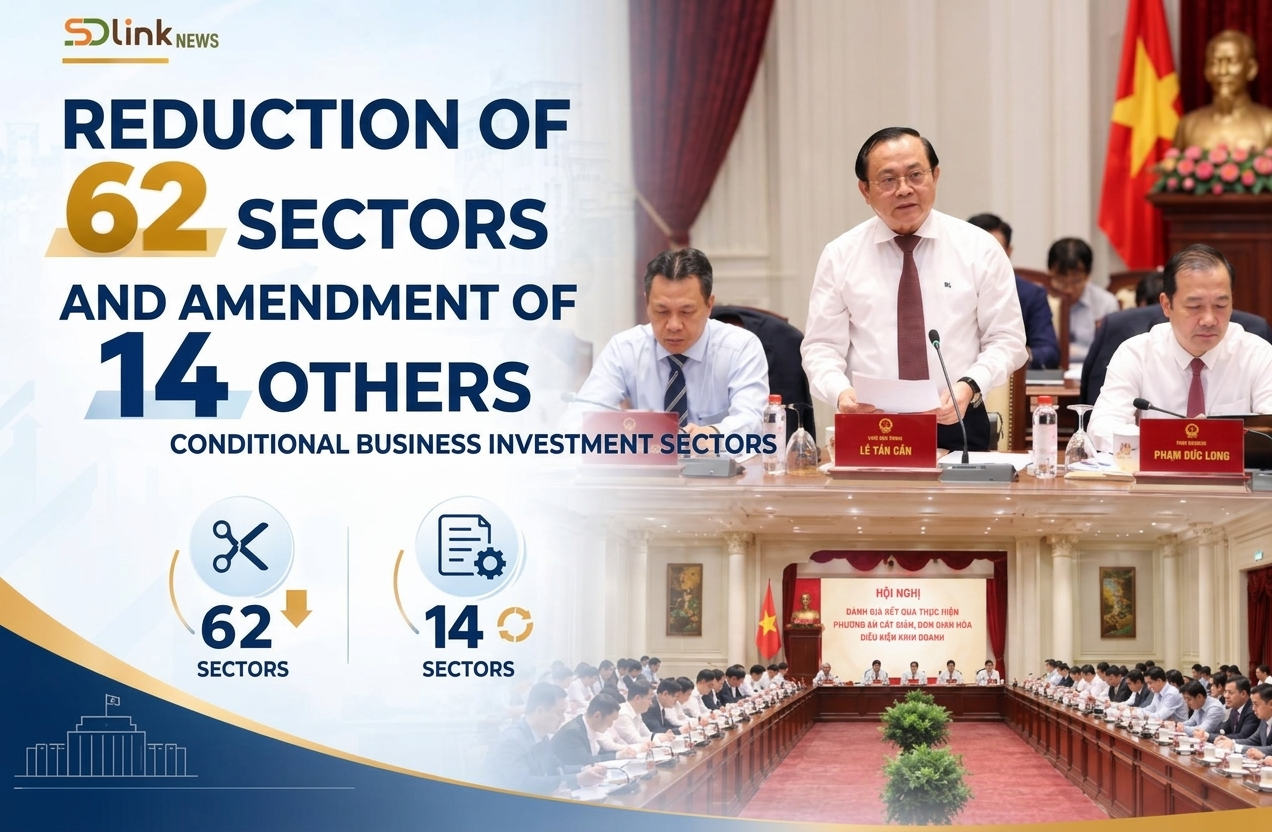
The Law amending and supplementing a number of articles of the Law on Investment, recently passed by the National Assembly, removes 62 sectors from the list of conditional business activities and amends 14 others, compared to the previous Law on Investment. Furthermore, the Law introduces a ban on the commercial use of nitrous oxide (N2O) for human inhalation—commonly known as "laughing gas"—except for specific purposes permitted by law.
Widespread reduction of conditional business sectors
At a press conference announcing the President’s order regarding laws passed by the National Assembly during its first extraordinary session, Deputy Minister of Finance Le Tan Can explained that the removal of 62 conditional business sectors and the amendment of 14 others were based on an assessment of risk levels, the feasibility of post-licensing oversight, and the capacity to ensure effective state management. The review focused on areas directly related to national defense, security, social order and safety, and public health. Through these measures, the policy seeks to create an open and transparent investment and business environment that aligns with international practices, shifting the regulatory focus from pre-licensing controls to post-licensing oversight. Additionally, the Law mandates that ministries and ministerial-level agencies conduct a comprehensive review of specialized legislation to address any provisions—whether direct or indirect—that impose conditions on the business sectors that have now been removed from the list. Where necessary, regulatory authorities must develop alternative measures, provided that these do not result in the creation of new licenses, administrative procedures, or business conditions in any other form.
Prohibition on the commercial trade of "laughing gas" (nitrous oxide)
A notable feature of the amended Law is the introduction of a ban on the commercial trade of nitrous oxide (N2O) intended for human inhalation. This provision will take effect on January 1, 2027, with exceptions for use in medical, food technology, testing, scientific research, and other purposes as specified by the Government. This new regulation aims to strengthen the oversight of the trade and use of N2O, while curbing activities that pose risks to public health, social order, and safety.
Addition of conditional business sectors
In addition to streamlining and amending various business sectors, the Law adds "visa support services provided by authorized business entities" to the list of conditional investment and business sectors. According to the Ministry of Finance, this addition is intended to enhance the regulation of activities that could potentially involve complex issues related to national security. The provision also seeks to restrict the participation of organizations or individuals that fail to meet the required criteria from operating within authorized visa application centers. Furthermore, it aims to prevent the leakage of personal information and data, as well as the organization of activities that facilitate the departure of Vietnamese citizens who subsequently remain abroad illegally.
The changes introduced by the Law amending and supplementing a number of articles of the Law on Investment are expected to further improve the business environment by reducing unnecessary conditions, increasing transparency, and enhancing the efficiency of state management. At the same time, the shift from *ex-ante* (pre-approval) to *ex-post* (post-approval) oversight provides businesses with greater flexibility to proactively invest and conduct operations, while ensuring that high-risk sectors remain subject to appropriate control. Changes to the list of business lines subject to conditional investment requirements necessitate that enterprises stay updated on policy developments to accurately determine their operational requirements and investment strategies. SDLink Investment Consulting offers professional services in investment and strategic planning, assisting businesses in researching investment conditions, assessing project viability, and guiding implementation in compliance with the law—thereby helping to mitigate risks throughout the project lifecycle.
Source: Government Portal