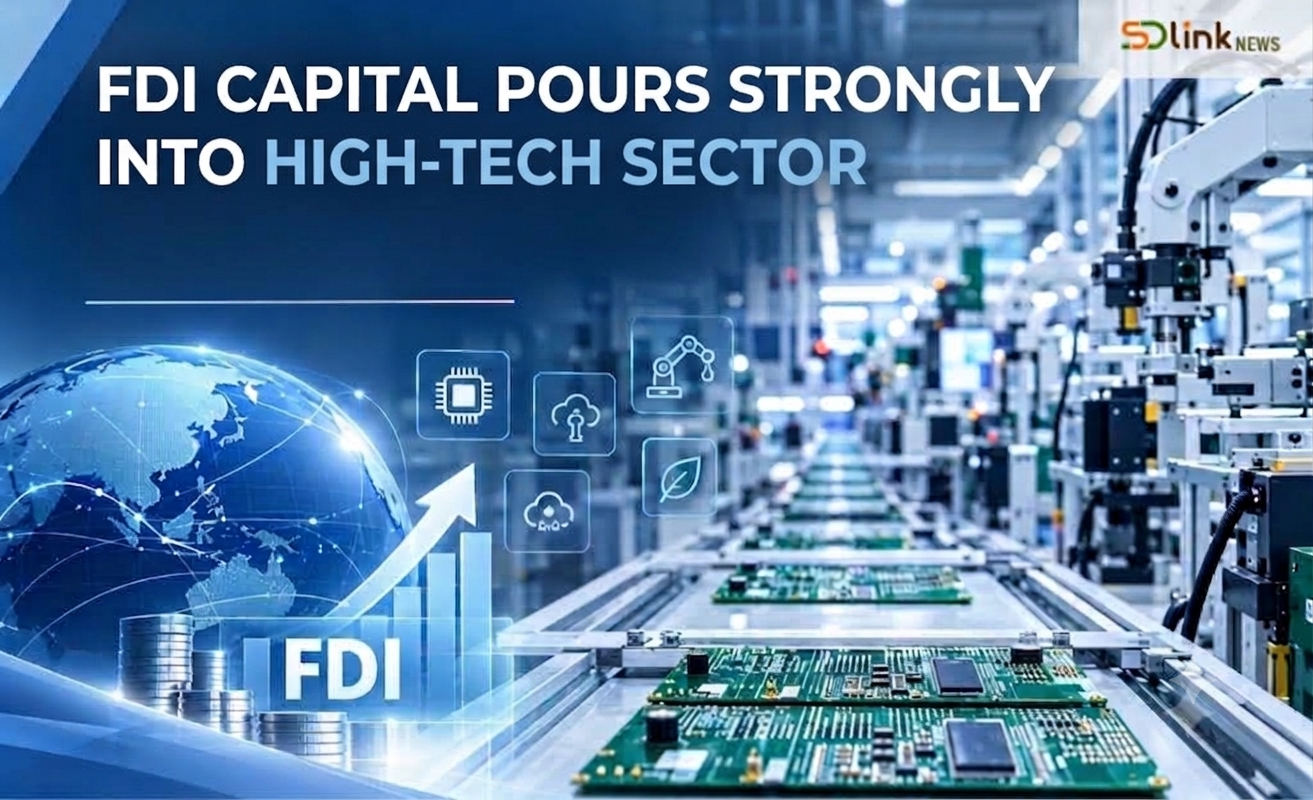
During the first six months of 2026, total registered FDI in Vietnam reached over $34.6 billion, up 61% compared to the same period the previous year. The manufacturing sector alone attracted more than $18 billion, continuing to serve as the primary driver of foreign investment inflows. Notably, while the number of newly registered manufacturing projects fell from 759 in the first half of 2025 to 468, the total newly registered capital still reached $10.71 billion. This indicates a shift in FDI trends from increasing project volume to focusing on large-scale, high-tech projects that offer higher added value.
The computer, electronics, and optical products sector stood out with over $7.03 billion in newly registered manufacturing FDI, accounting for nearly 66% of the total new manufacturing FDI. Despite a decline in the number of projects, investment capital in the electronics industry surged by 614%, demonstrating that international investors are intensifying activities in areas such as semiconductors, electronic components, precision engineering, and advanced technology. This trend is further evidenced by the emergence of very large-scale projects. The three largest new manufacturing projects in the first half of the year had a combined capital of approximately $6.36 billion—accounting for nearly 60% of total newly registered manufacturing FDI—and included projects from Samsung Semiconductor Asia Holdings, Samsung Electro-Mechanics Vietnam, and LG Innotek Vietnam. Geographically, Northern Vietnam remains a prime destination for manufacturing FDI, attracting approximately US$8.63 billion—equivalent to 80.5% of the country's total newly registered capital. Thai Nguyen leads the region with about US$5.77 billion, while Hai Phong, Hung Yen, and Bac Ninh continue to play pivotal roles in the electronics and high-tech manufacturing ecosystem. Beyond electronics and semiconductors, sectors such as mechanical engineering, electrical equipment, metal products, rubber, plastics, food processing, and the automotive industry continue to see robust investment activity. This indicates that Vietnam is gradually establishing a multi-sector manufacturing ecosystem rather than relying on a single industry.
FDI inflows in 2026 are demonstrating a shift in quality. Project scale, technological sophistication, production capacity, and positioning within the global supply chain are increasingly critical factors in evaluating the effectiveness of Vietnam's FDI attraction efforts. SDLink partners with businesses and investors on market research, investment strategy, site selection, and planning consultancy, helping to build a foundation for effective project development that aligns with the industrial and economic goals of specific localities.
Source: Tien Phong Newspaper