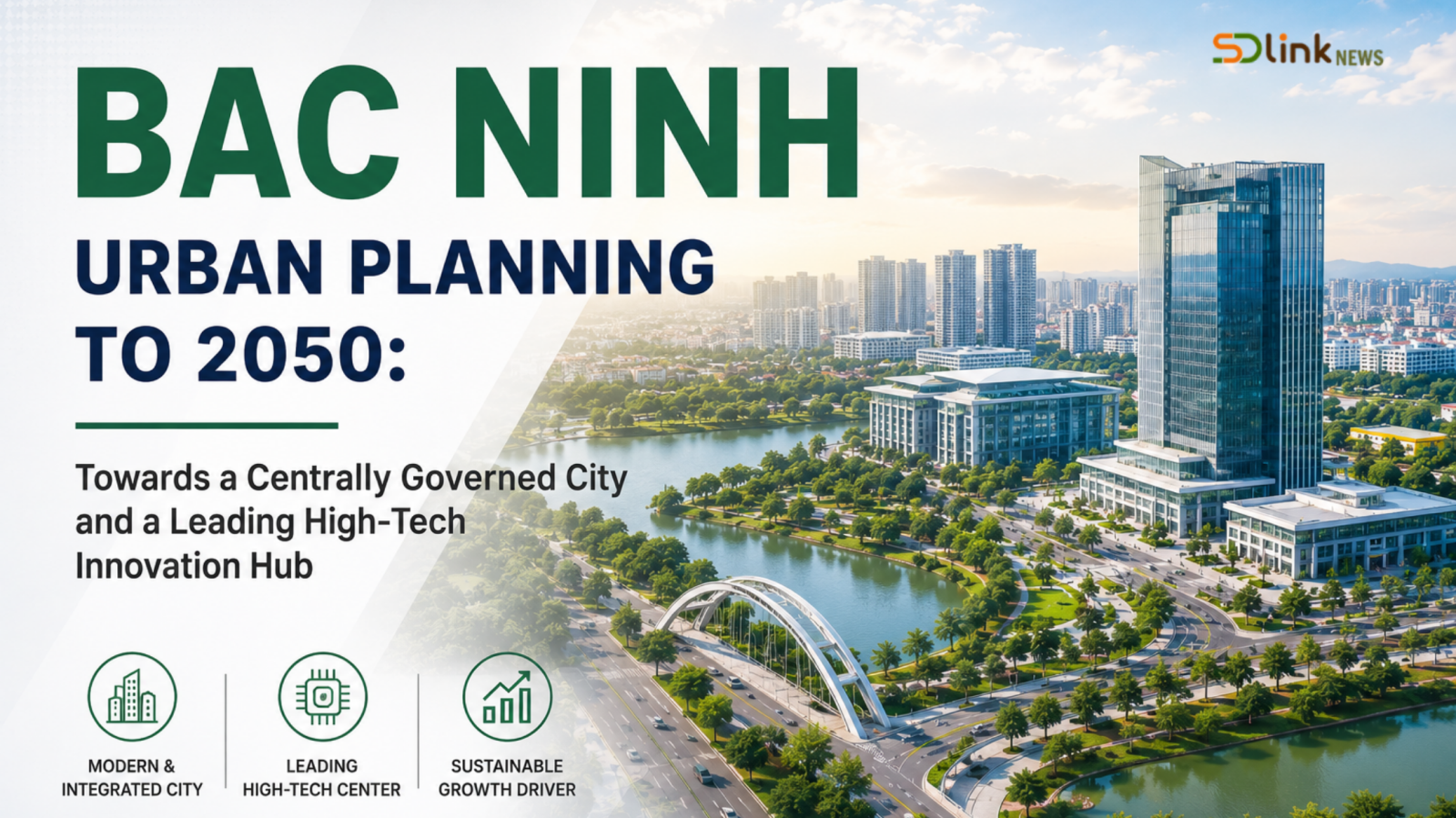
On July 23, 2026, Deputy Prime Minister Pham Gia Tuc signed Decision No. 1389/QD-TTg approving the General Urban Planning of Bac Ninh until 2050, with a vision to 2075. The new plan is expected to transform Bac Ninh into a Class I city, a centrally governed city before 2030, and an important economic growth pole in the Northern region. According to the planning orientation, Bac Ninh will develop according to the model of a green, smart, civilized, and modern city, with science and technology, innovation, and digital transformation as the driving force for development. At the same time, the province aims to build a green economy, a circular economy, reduce emissions, and improve the quality of life for its people, linking economic growth with sustainable development.
One of the highlights of the plan is to make Bac Ninh the national center for electronics, semiconductor, microchip manufacturing, and artificial intelligence, gradually participating more deeply in the global technology supply chain. By 2040, the province aims to form a balanced economy between high-tech industries, services, and logistics; and by 2050, to become a livable city of regional Asian standards, operating on a digital economy and innovation platform. In terms of development space, Bac Ninh will be organized according to a multi-polar, multi-center model, comprising 3 development zones, 4 strategic economic corridors, and 6 dynamic clusters. The central zone will focus on developing high-tech industries, electronics, and semiconductors; the southern zone will develop trade, logistics, and an aviation city connected to Gia Binh International Airport; and the eastern zone will prioritize the development of high-tech agriculture, forestry, and ecotourism.
The plan also allocates significant resources to the development of socio-economic infrastructure. The area of industrial parks is expected to expand to approximately 25,000 hectares, focusing on attracting high-tech industries such as semiconductors, AI, R&D, unmanned aerial vehicles, and the aviation industry. Simultaneously, existing industrial parks will gradually transform into eco-industrial parks and new-generation industrial-urban-service zones. The logistics sector has been identified as one of the new growth drivers, with three key logistics centers in Que Vo, Gia Binh, and Kep, integrating road, rail, waterway, and air transport. Bac Ninh is also studying the development of a free trade zone linked to Gia Binh International Airport to enhance international trade connectivity and attract investment.
Besides industry and logistics, the plan continues to leverage its strengths in culture and agriculture. Bac Ninh will develop Kinh Bac cultural tourism products, ecotourism, MICE tourism, and expand high-tech agricultural zones and specialized fruit-growing areas, contributing to diversifying the economic structure and enhancing sustainable development. The approval of the Bac Ninh Urban Master Plan not only provides a legal basis for urban development management but also opens up many opportunities to attract investment in high-tech fields, infrastructure, logistics, industrial real estate, and services. This is considered a crucial step towards realizing the goal of making Bac Ninh a dynamic development center of the Capital Region and the Northern region in the coming decades.
In the context of Bac Ninh's accelerated infrastructure development, urban expansion, and attraction of high-tech projects, the demand for investment consulting and project implementation support is increasing. With experience in investment consulting, SDLINK accompanies businesses and investors throughout the process of researching opportunities, providing legal advice, selecting locations, carrying out investment procedures, and connecting with the business ecosystem in Vietnam. SDLINK's support helps businesses effectively access new policies, optimize project implementation, and seize development opportunities from national and local strategic plans.
Source: Government Electronic Newspaper