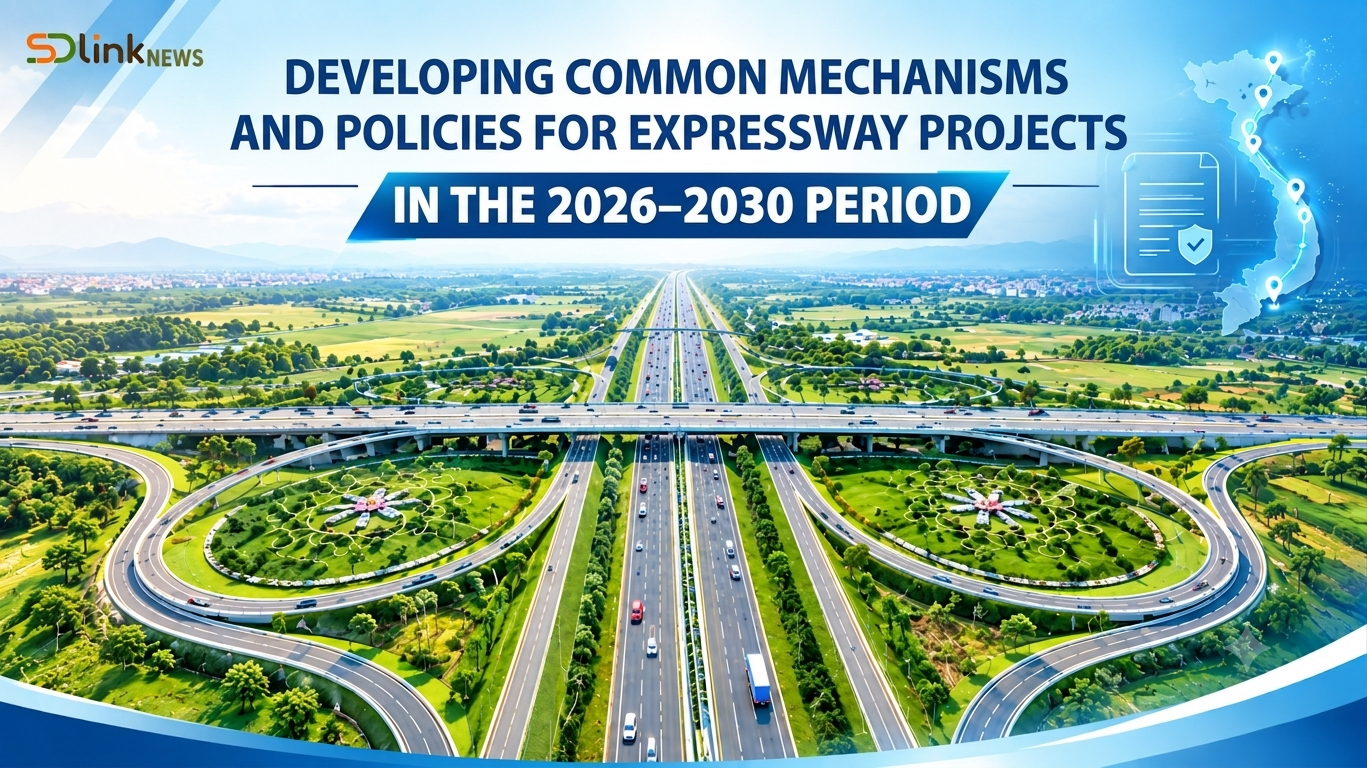
The Government Office recently issued Document No. 8941/VPCP-CN dated August 30, 2026, conveying the directives of Permanent Deputy Prime Minister Pham Gia Tuc regarding common mechanisms and policies for expressways in the 2026–2030 period. Accordingly, the Ministry of Construction is tasked with incorporating feedback from relevant ministries and agencies and thoroughly reviewing regulations concerning the state budget, public investment, Public-Private Partnerships (PPP), construction, bidding, planning, minerals, and land to specifically identify difficulties and obstacles encountered during implementation.
Should it become necessary to expand specific mechanisms and policies previously applied to certain projects, the Ministry of Construction must summarize the situation, fully assess the impacts, and adhere strictly to established procedures and jurisdictional authority. This approach aims to ensure consistency and fairness in legal enforcement while establishing a clear legal basis to accelerate the progress of expressways and national key projects.
According to a report dated August 24, 2026, the Ministry of Construction noted that various special mechanisms have been repeatedly applied to projects of a similar nature. However, the requirement for individual projects to seek a specific National Assembly resolution can prolong the investment preparation phase and lead to inconsistent handling across different projects. This is one of the reasons prompting the need to study a mechanism that can be applied universally.
To accelerate progress, mobilize resources, and enhance decentralization and the delegation of authority, the Ministry of Construction has proposed that the Government adopt specific mechanisms and policies—originally applied to the Ring Road 5 project—for public investment-funded expressway projects during the 2026–2030 period. If properly studied and implemented, such a unified mechanism could help shorten project preparation times, improve investment efficiency, and ensure consistency in execution.
Refining policies for expressway projects is crucial for infrastructure development, regional connectivity, and the expansion of economic space. Alongside construction investment, resolving bottlenecks related to planning, land, funding, and administrative procedures will be key to the effective implementation of future projects. Amidst the current push for infrastructure and planning development, SDLINK provides consultancy solutions in investment and planning, assisting businesses and investors in exploring development directions, assessing opportunities, and formulating plans that align with both regulations and the specific conditions of each project.
Source: Government News Portal